

Fernando Esteso was born in Zaragoza on February 16, 1945.
His relationship with the world of show was quite early. It belongs to the stretch of a great japanese family. From a small point of view, he was singing jota and acting in his parents' variety company.
He moved to Madrid in 1964 at the age of 19, where he soon debuted as a theatre actor and by 1972 he performed with his own show. In the 1970s he became popular as a humorist in various television shows, recording Iberian humour classics like the commercial of the Coñac La Parra. In 1973 he participated in his first film: Celos, love and common market, which served him to start his career in the world of cinema. He then became famous for the humorous-cut films that, together with Andrés Pajares, played in the late '70s and early' 80s, turning simultaneously throughout Spain with the magazine company of both.
It is the epoch of titles directed by Mariano Ozores, true lockers, and co-starring Andrés Pajares as famous as Los Bingueros, I made Roque III and other feature films only starring him, like Pepito Piscinas, The priest already has a son, or East West.
He was also very successful as a singer and imitator, intervening in the infinity of TVE programs. His best known songs were Bellotero pop and La Ramona. He participated in the Benidorm Festival with the song of Augusto Algueró I am a vivivor.
Later, in 1987, he starred with Pajares the play "The Strange Couple," by Neil Simon, premiered at the Calderón Theatre in Madrid.
After more than ten years of continuous work in Spanish cinema, most of them embodies characters of a comic type with great success of locker, starring in 1991, Love does have a cure, by Javier Aguirre. He appears in cameos in two of the "Torrentes" of Santiago Segura.
In 2011 he recorded a new version of his song "La Ramona" with King Africa.
It is still active. He has intervened in episodes of Amar is forever and just before Christ as well as in the last two films of the great director sadly missing Agustí Villaronga: Uncertain Gloria and Loli Tormenta.
Year: 1981
Duration: 85 min.
Country: Spain
Address: Mariano Ozores
Script: Mariano Ozores
Music: Gregorio García Segura
Photography: Leopold Villaseñor
Cast: Alfonso del Real, Andrés Pajares, Fernando Esteso, Adriana Vega, Marcia Bell, Emiliano Redondo, Loreta Tovar, Antonio Ozores
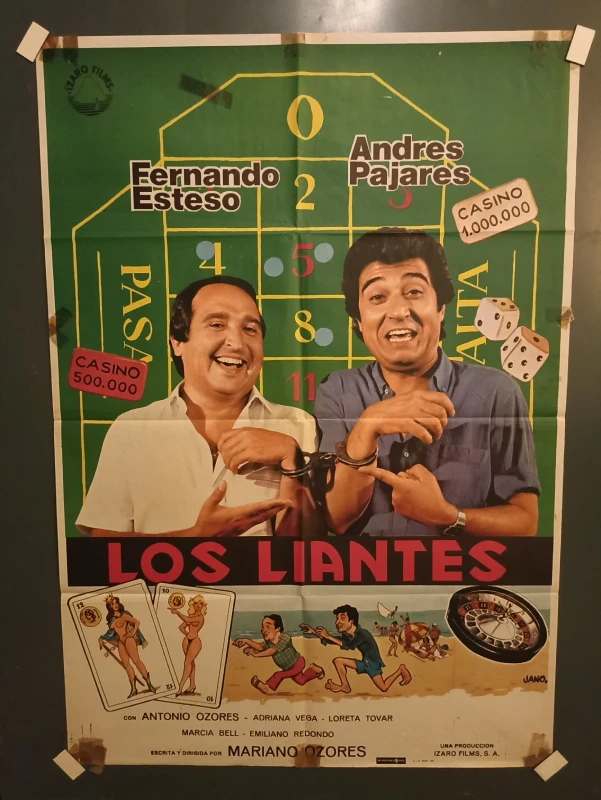
Overview: Amador and Fidel are two beach timers that act in and around Torremolinos. To put an end to the little fortune they get in their mos, Eduardo, friend of the two and brain of the group, has the idea of making a millionaire believe that Amador is a lucky man-elephant. Amador ends up believing the charade and one night he goes to the casino to spend all the money they had made. The three of you must then try to recover the lost money.
«When, in 2016, and about a short film we were shooting on Mariano Ozores, we projected The bingueros at the Golem cinema in Madrid, not only filled the room, but the public, of all age and social and cultural condition, laughed where both the spectators of its premiere in 1979 and the following ones when renting it on video or watching it on television passes. And this means that Mariano Ozores not only continues to have a certain pull, but he handled the springs of comedy very well; of a very visceral comedy, that is. To the point that, 40 years later, their graces continue to be effective, although with important nuances.
In the cinema Golem the chirps were always accompanied by an exclamation of astonishment, or a "how strong." A sincere reaction to the film's tone exits or an immediate way of counteracting, and minimizing, the crazed by pure guilt? The jokes of The Bingeros, such as those of the rest of the tandem films Andrés Pajares and Fernando Esteso, including the liantes, much more irreverent than the one cited, continue to cause the hilarity, but it is nuanced by the filter of the evolution of times... and self-censorship. To make the mood of Pajares- This is unthinkable, but the viewer has to know how to put on the glasses of that of the 80's so as not to demonize them too much. The film of Ozores is a magnificent show of how we were then the Spaniards: repressed, pacatos, atollated on certain issues, such as sex. The male characters of The Bingeros, or The Lilies, have nothing to say. They're ridiculous guys, full of shortcomings, at all basic... In contrast, and although, and this is undeniable, female characters are used to strip them "by the requirements of the script" (or not), they are almost always freer and stronger. See here the Dolores of Adriana Vega (eye, I'm not saying that I'm a fan of feminism or that Mariano Ozores claims any of this).
The lilies, shot in large part on the Costa del Sol, in particular on Torremolinos (Bajondillo beach...) and Benalmádena (inside the casino of Torrebrabada...), are seen in that great film by Pedro Lazaga, Los tramposos (1959), and also welcomes the Bingeros own. Next to this, the liantes is one of the most celebrated deliveries of the comic duo. This is Pajares (Amador) and Fidel (Esteso), and the brain of the group, Eduardo (Antonio Ozores), are making a living by deceiving anyone who gets ahead of them, either with a simple camel to a tourist on the beach or with a more "elaborate" plan to steal a ricachon in a casino: they make this Sixto (Emiliano Redondo) believe that Amador is an "elephant man," an individual who is lucky.
As Mariano Ozores told us in I wanted to do Los Bingueros 2 (2016), his films were all fun and, as he shows, a button: in Los liantes, Amador and Fidel they accidentally entered a washing tunnel and Andrés and Fernando actually got in. On the way out, Pajares shouted that he had to have suspected the bad drink when he found that Mariano did not put his brother Antonio, who appears in that sequence as mere observer.
With Pajares and Esteso at the top of their careers, the liantes was another success in the film saga: it was watched by 1,130,994 spectators and collected 187,003,593.22 pesetas). (1.126.527.67 €). And that's not counting the rent on the videclub... for which you had to take up to the number.
When you see the lilies on your pass at the FICCAB remember to put on a few glasses of the time, leave aside the current prejudices and, if you laugh, if you laugh, don't feel bad. Enjoy and, in any case, reflect later on how we have changed. Have we really changed or do we keep the guy why they'll say? You have the answer»
José Manuel Serrano Cueto-
House of Culture. Pz. de Austria, s / n. 29631. Honey Arroyo. Benalmádena.

FICCAB © 2025 by agdezavisual 6/ Alejandro Ruiz