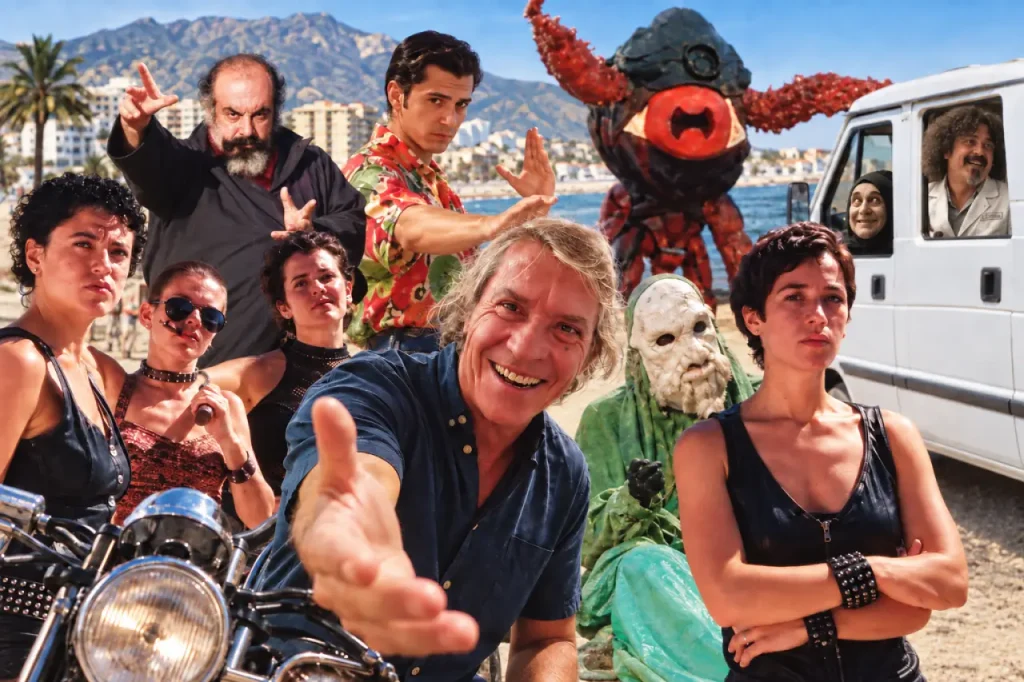
There are directors who build a film and others who build a universe. Pedro Temboury It belongs, fortunately, to the seconds. In his cabins castrator mats, resurrected karatekas, Catholic surfers, crazy scientists, sea monsters and even Adolf Hitler's incorruted penis. All this with Málaga, Torremolinos and the Costa del Sol as unlikely scenarios of a fantastic cinema proudly gamberro.
Born in Malaga in 1971, Pedro Temboury is a director, writer and producer, and one of the most unique figures of Andalusian underground cinema. Nieto of the historian and defender of the Malagasy heritage Juan Temboury, developed from a very young age a passion for fantastic cinema, terror, series B and all those genres that usually enter the back door of the official history of cinema.
His meeting with Jesus Franco, of whom he was a disciple, a collaborator and a management assistant, was decisive in his formation. From Jess he surely inherited something more important than any cinematographic technique: the conviction that making films does not always require permission. Instead of concealing their influences, Temboury decided to celebrate them and add something unambiguously his own: Malagasy humor, friends, few media, beer and an imagination that never seemed to be too concerned about the word «excess».
Before addressing the feature film he began to manufacture his particular universe in short films such as Life and Death of a record collector (1992), Psycho-lettes (1996) or Adolescent Generator (1998). And precisely 2026 offers a magnificent excuse to return to that first stage.
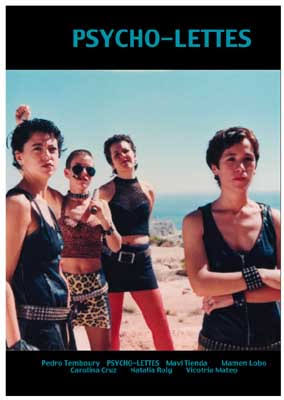
Thirty years ago, Psycho-lettes appeared, a short film of just ten minutes starring a band of mothers that runs the Andalusian roads, sowing male terror and genital mutilation. Much of the DNA of the future Temboury cinema was already there: gore, provocation, humor, dangerous women and a contagious enthusiasm for the exploitation cinema.
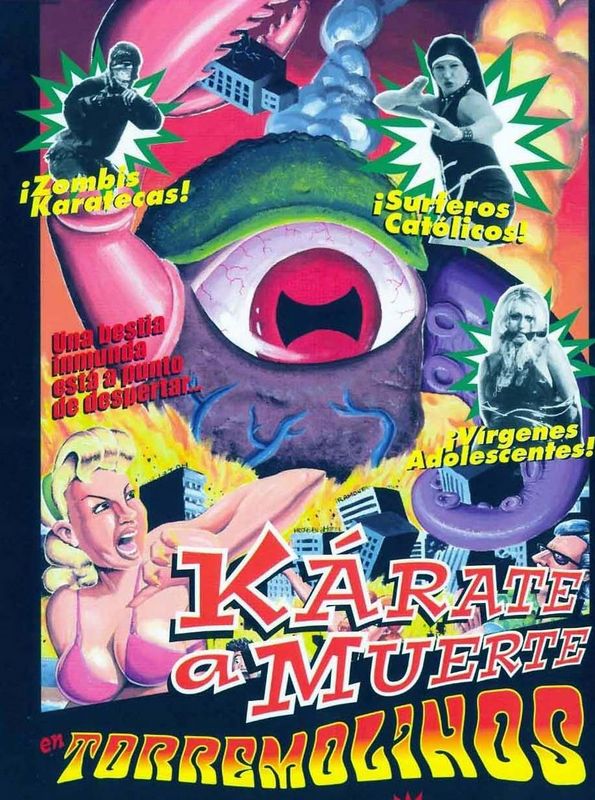
Five years later came the film that would end up becoming its most emblematic work: Kárate to death in Torremolinos (2001), which in 2026 is a quarter of a century since its production. His argument continues to be difficult to summarize without giving up a chuckle: a crazy scientist, resurrected karatekas, a Catholic surfer and Jocantaro, a half octopus and half centollo creature, faced on the Costa del Sol. Written by Temboury along with Pablo Alvarez, the film made Torremolinos the stage of a delusion celebration of the B series cinema against all prognosis —or perhaps precisely because of it.— won the Public Prize for the Fantastic Film Week in Málaga in 2002 and ended up becoming a small cult work of independent Spanish cinema.
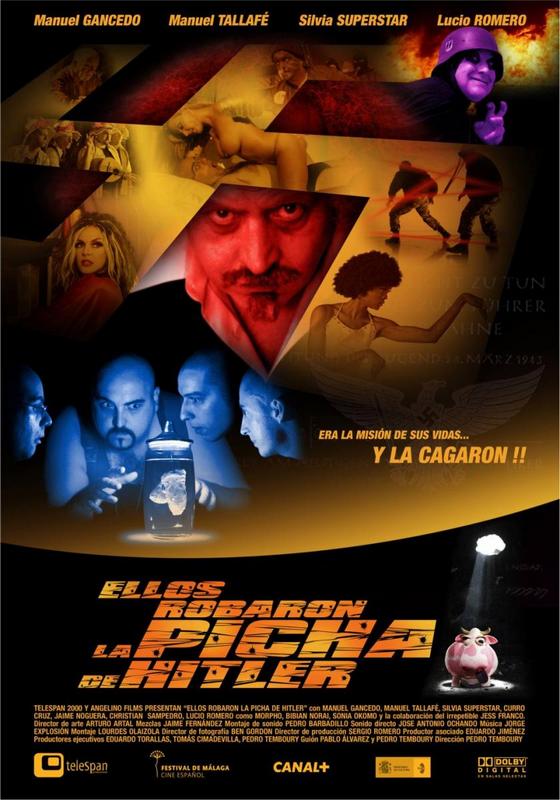
And 2026 also marks twenty years since they stole Hitler's spike (2006) he appeared at the Málaga Festival. Temboury again showed that, when it seemed impossible to overcome the title of his previous film, there was always a possibility. Malagueños Nazis, Amazonas, a scientist hidden in Torremolinos and Hitler's canopy preserved in an urn starred in a film that the director himself then defined in an insurmountable way: a mixture of Frankenstein and Mission: Impossible «at the rate of verdials».
But behind all the voluntary dandruff, the false blood and the impossible arguments there is something quite more serious: a huge love for making movies. Temboury shot Kárate to death in Torremolinos taking advantage of the holidays of his work and spent later weekends for a year riding it. His films were born of enthusiasm, of the collaboration of friends and of the obstination to bring forward stories that could hardly exist within the conventional channels of Spanish cinema.
Over time, that curiosity also led him to the documentary, but without abandoning his interest in alternative cultures, pioneers and characters living outside the dominant currents. In Skateboard (2013) he approached the origins of skate culture in Spain and in The first wave (2015) he recovered the memory of the Spanish surf pioneers. He also returned to one of the fundamental figures of his formation with Jess Franco's last film, thus prolonging the dialogue with the filmmaker who had marked his first steps.
Fantastic, terror, punk, surfing, martial arts, series B, cinema of exploitation and popular culture thus form the pieces of a path deeply linked to Málaga and the Costa del Sol. A film made from the margins, but also from a creative freedom that explains that his films continue to find spectators years after they were shot.
Thirty years of Psycho- lettes, twenty-five of Kárate to death in Torremolinos and twenty of them stole Hitler's spike. Three round anniversaries to celebrate a filmmaker who got something quite more difficult than making perfect movies: making movies that no one could confuse with those of another director.
Year: 1996
Duration: 10 min.
Country: Spain
Script and Address: Pedro Temboury
Cast: Carolina Cruz, Victoria Mateos, Mavi Testión, Mamem Lobo, Natalia Rojo, Alberto González, Pepe Pote Botica, Fabián Muñoz, Dani Mateos, Perdi Dols, Víctor Carrasco, Emilio Schargorodsky, Manolo García
Overview: A band of mothers known as the Psycho- lettes runs through the roads of southern Spain by attacking men and collecting their viile members as trophies. They are followed by Captain Loperena of the Civil Guard and his assistant, who is willing to end his running.
Conceived from the black mood, the excess and aesthetics of the B-series cinema, this short film by Pedro Temboury unfolds in just ten minutes a delusional universe of mothers, violence, blood and impossible creatures.
Year: 2001
Duration: 79 min.
Country: Spain
Address: Pedro Temboury
Script: Pedro Temboury, Pablo Alvarez
Photography: Fulgencio Martínez
Music: Jorge Explosion
Assembly: Lourdes Olaizola
Artistic direction: Carlota Boots
Production: Thomas Cimadevilla, Bethlehem Atienza, Peter Temboury
Cast: Curro Cruz, Sonia Okomo, Paul Lapidus, Jesús Franco, Olivier Denis, Julio Sanjuán, Juanma Lara, Pedro Temboury, Lucio Romero
Gender: Fantasy
Overview: Torremolinos, year 2000. The malevolent Dr. Malvarios arrives on the Costa del Sol with a plan to dominate the world: to resurrect four karatekas drowned in Malaga Bay and use them to kidnap five young people. With them he aims to awaken the fearsome Jocantaro, a creature half a cent and half an octopus.
To stop him, Jess, a Catholic surfer and celibate, brings together a peculiar group of allies and lends himself to the rescue of his girlfriend Danuta. Martial arts, zombies, sea monsters and series B are mixed in the delirious first feature film by Pedro Temboury.
Year: 2006
Duration: 85 min.
Country: Spain
Address: Pedro Temboury
Script: Pedro Temboury, Pablo Alvarez
Photography: Benjamin Gordon
Music: Jorge Muñoz Cobos
Executive production: Eduardo Torallas
Production: Telesman 2000, Angelino Films
Cast: Manuel Gancedo, Manuel Tallafé, Lucio Romero, Jaime Noguera, Christian Sampedro, Jesús Franco, Silvia Superstar, Bibian Norai, Sonia Okomo, Victoria Martín, Carolina Cruz, Johann Wald
Gender: Comedy
Overview: Berlin, 2006. Turkish workers discover Adolf Hitler's secret bunker. Inside, guarded by Eva Braun's body, the incorruted member of the Führer appears in an urn.
The news comes to Dr. Weissmann, an old Nazi scientist hidden in Torremolinos who intends to use it to create a new Hitler. To get him back, he recruits four Malagasy neo-Nazis, who must travel to Berlin and have the unusual trophy. But on his way there will be a secret society of dangerous Amazons who also want to take over him.
House of Culture. Pz. de Austria, s / n. 29631. Honey Arroyo. Benalmádena.

FICCAB © 2026 by agdezavisual 6/ Alejandro Ruiz